Crew's strep and scarlet-fever illness
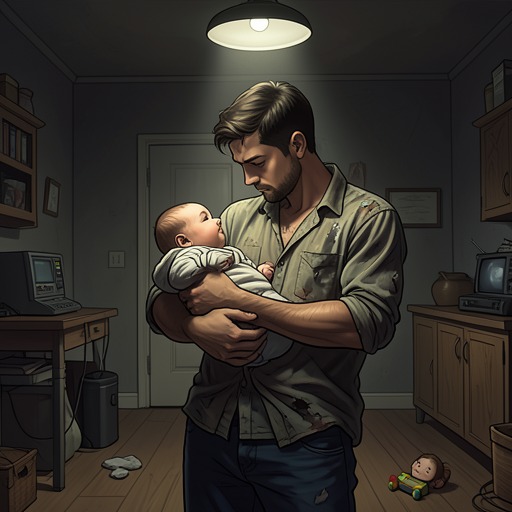
Hayden's TimbreCrew's strep and scarlet-fever illness is a turning-point episode in which an apparently ordinary sickness becomes a test of Hayden Devillier's single-parent responsibility. Crew's worsening condition produces a concrete medical crisis, but the event also clarifies the family rule that governs Hayden's choices: when professional obligations conflict with his son's safety, Crew comes first.
Causes and Background
Hayden Devillier had never intended to become a father so young. Crew Devillier was born when Hayden was eighteen, and Crew's mother abandoned him, signed over all rights, and never called to check on him. Hayden therefore became the only parent consistently responsible for Crew, relying on the example of his own mother and grandparents while learning parenthood without an instruction manual. He describes loving Crew completely, while acknowledging that the child's future adolescence will bring more difficult challenges and require him to remain alert and involved.
Crew's asthma had already shaped Hayden's understanding of parental risk. Crew developed asthma at about four, and his allergy to cats made Hayden wary of being away with the band while Crew was young. Hayden feared that an emergency might occur while he was traveling and that he might be unable to reach his son quickly. The illness episode extends that established fear from a known chronic vulnerability into a rapidly changing condition whose seriousness is initially unclear.
What Happens
Crew first seems ill enough to be taken home, but when he stands he becomes unsteady and nearly collapses. Hayden catches him, notices that his eyes appear ready to roll back, and realizes that Crew is worse rather than better. When Hayden presses Crew's forehead to his cheek, he finds that the boy's skin is burning with fever. Crew says he feels sick and is about to vomit, then vomits over both of them before Hayden can get him fully into the bathroom.
Hayden gets Crew cleaned up and summons Peri Powell, who arrives while Crew continues vomiting. A washcloth is used to lower his fever, but removing Crew's filthy shirt reveals a strange red, raised rash across his skin. Neither Hayden nor Peri knows what the rash means, so Peri goes to ask Nanny, whose experience with children may provide an answer. The rash changes the apparent nature of the illness: this is no longer simply a fever or an undifferentiated virus but a condition requiring a more informed medical judgment.
Nanny suspects scarlet fever and asks whether the doctor performed a strep test. The earlier test had been negative, but she explains that the result may have come too early and therefore cannot safely rule out the infection. Hayden carries the weak boy downstairs, puts a clean shirt on him, settles him in the truck with a garbage bag, and drives him to the hospital. At the emergency room, the doctor takes one look at Crew and orders another strep test, expecting it to be positive. The second test confirms the infection, and the doctor prescribes antibiotics.
The doctor warns that scarlet fever could become a serious problem if it is not treated quickly, although Crew had not yet displayed the rash during the earlier office visit and the family appears to have caught the condition in time. Hayden accepts the responsibility without hesitation, promising that Crew will be watched. The illness therefore moves through three stages within the scene: presumed minor sickness, alarming physical deterioration, and medically confirmed infection requiring treatment and continued observation.
Consequences and Aftermath
The episode immediately changes Hayden's professional plans. A major show has been prepared through long practice, and Peri reminds him that the performance is important and that canceling would leave the band to find someone else. Hayden nevertheless decides to cancel because Crew's health overrides the concert. He also refuses to ask Timbre Simons to take over the obligation, making clear that the emergency is his responsibility rather than a burden he should transfer to her.
Hayden's response is not emotionally simple. Earlier, when Timbre Simons described being endangered alone on a night bus, Hayden reacted with furious fear, listing the weapons and possible violence that could have been involved before pulling her into his arms and apologizing for yelling. Crew's illness produces a related pattern: danger first appears as anger, alarm, and bodily urgency, but effective care requires action rather than accusation. With Crew, Hayden gets the child to the bathroom, calls Peri, consults Nanny, drives to the emergency room, obtains treatment, and prepares to monitor him. The event shows his protectiveness becoming practical parental labor.
The illness also reinforces the contrast between Hayden's public identity as a rock star and his private identity as Crew's father. Touring, rehearsals, and a major performance belong to the world that can demand his presence elsewhere; fever, vomit, rash, antibiotics, and observation belong to the immediate domestic world that cannot be postponed. His decision to abandon the show gives the principle of parental priority a material cost. It is not merely an affectionate declaration but a choice that reorganizes his schedule and places his career temporarily second.
Narrative Significance
Crew's strep and scarlet-fever illness functions as both a medical plot event and a relationship test. Hayden's bond with Crew was formed under abandonment and sustained through self-reliance, yet the crisis demonstrates that self-reliance does not mean refusing assistance. Hayden accepts help from Peri and Nanny, listens to Nanny's warning about the unreliable early test, and follows the doctor's treatment plan. The family protects Crew through coordinated care rather than through Hayden's solitary effort alone.
The scene also resists treating illness as a moral defect. Crew's dangerous condition is not caused by disobedience or bad character; the danger lies in the body's fever, vomiting, rash, and the possibility that untreated scarlet fever may worsen. The narrative's medical recognition matters because it corrects uncertainty without turning sickness into a metaphor for guilt. At the same time, the physical symptoms transmit fear through the household: Crew's burning skin and weakness make the adults' ignorance visible, while Hayden's fear becomes action that reaches the hospital before the condition escalates.
Within the broader story, the illness confirms the rule that defines Hayden's romantic and professional life: Crew's welfare comes first. It deepens the significance of Hayden and Timbre Simons's developing relationship by showing that Timbre is not asked to compete with Crew or absorb responsibilities that belong to Hayden. It also prepares the emotional logic of Hayden's later family decisions. The crisis ends not with a performance preserved at any cost, but with treatment, surveillance, and a father choosing the vulnerable child whose safety depends on him.